Thursday, 24 April 2014

The Next War - Operation Attila D+3 (NATO Land Move Finished)

With NATO command chain back to normality, the fighting in Central Europe continues....


NORTHAG Movements

North Army Group decided to focus on two strongpoints. 
The first is Hamburg, where 11th German Division and two Landwehr mech Brigades are entrenched. Mixed Bunderswehr brigades and elements from Danish Army hold the line North of the city.
Hamburg area, D+3 23:00 Zulu Time

The second strongpoint is of the course the Ruhr area, where French I Corps moved in defense with an impressive support in artillery, German reserve Regiments and the whole British 4th Division.
Moreover, NATO helicopters using NOE flying attacked every single crossroad and bridge East of their front line, making movement a nightmare for 1st Guards Tank Army.
The Ruhr area, D+3 23:00 Zulu Time
(the two Soviet airborne divisions landed in the Ruhr are in the only 2 hexes not occupied by NATO units)

Finally, a German airborne brigade was moved by helicopters at Kassel, taking back the undefended city.

CENTAG Movements

Not much happened in the Central Army Group area, except for US F4 and French Mirage making an heavy raid at Papa airport, Hungary. Despite taking several losses, the raid was able to destroy the SAM-2 battery covering the area and damage the airport staging several Soviet Mig-23 and the whole Hungarian air force. 
Frankfurt area, D+3 23:00 Zulu Time

SOUTHAG Movements

In South Army Group area, German II Corps retreated further West, while French II Corps formed a second line of defense behind them. German 1st alpine Division was unable to disengage and remained at Munich.
Munich area, D+3 23:00 Zulu Time

At nightfall of D+3, NATO situation does not look very good, but German reservists arrival gave NORTHAG some additional troops to hold the line.
Overall situation at D+3, 23:00 Zulu Time


Monday, 7 April 2014

***** FLASH ****** WP Raid over SHAPE

Due to an heavy SU 19 incursion over the Supreme Headquarters of Allied Powers Europe (SHAPE) at Mons, Belgium, NATO command chain has been temporarily disabled and no orders are being issued to AFCENT.

General Bernard William Rogers, NATO's Supreme Allied Commander in Europe, has been wounded during the attack but is expected back on the command chair in a few days.


Thursday, 3 April 2014

The Next War - Operation Attila - D+3 18:00 ZT

General Staff of the Armed Forces of Soviet Union Wartime Headquarters
Chekhov, D+3, 18:00 Zulu Time

"Have you read the last report from Korochkin?"  said Nikolai Ogarkov, throwing the 50-pages report at his subordinate. As Chief of the General Staff, he had lots of enemies, most of them people with enough power to destroy a man's life in a matter of seconds. But Comrade Marshal Viktor Kulikov was not one of them. They knew each other since the Great Patriotic War and he was one of the few high rank officers who shared his vision about the deep structural reforms needed in Soviet Union, both in the military and civilian apparatus.

Kulikov took the report with a sardonic grin. "It will be bigger than 'War and Peace' in a few days! I presume truth hides better inside a couple volumes of lies."

D+0
D+1
D+3

Steps
Variation
Steps
Variation
Steps
Variation
MIG 23
42
100%
37
88%
35
83%
MIG 21
180
100%
162
90%
142
79%
MIG 19
8
100%
7
88%
7
88%
SU 20
6
100%
6
100%
6
100%
SU 19
12
100%
12
100%
12
100%
SU 17
18
100%
18
100%
18
100%
SU 7
24
100%
21
88%
19
79%
MIG 17
48
100%
47
98%
46
96%
MIG 15
6
100%
6
100%
6
100%
MIG 21 R
32
100%
32
100%
30
94%
YAK 28 R
2
100%
2
100%
2
100%
L 29 R
6
100%
6
100%
5
83%
IL 14 R
6
100%
6
100%
6
100%
Transport
22
100%
22
100%
22
100%
16 Vozdushnaya Armiya situation assessment, D+3, 12:00 Zulu Time


"Yes, and it's a very harsh truth." Ogarkov replied. "TWENTY FIVE percent losses in our fighter squadrons! twenty percent of lost combat power, taking into account the reinforcements. And almost not a single word about damaged aircraft, that obviously 'will be almost totally repaired before D+4 dawn'. Repaired before dawn MY ASS. We perfectly know most of those aircraft will never fly again."
"Moreover, according to GRU, NATO has just received sixteen new F-4 squadrons from United States. SIXTEEN! Viktor, they are going to fuck us very, VERY hard."

"True, Nikolai. On the positive side, our land offensive is making good progress. NORTHAG is on the verge of collapse. The British are yet not able to establish a solid defence line, and we inflicted them heavy losses."

"Not good enough. " Ogarkov stood up from his chair. "Viktor, I want you to push West faster than ever. I want to see your T-72 FLY. I want them moving around strongpoints, slipping in defence gaps, JUMPING OVER OBSTACLES." 
"Just move WEST, Viktor. If we are fast and able enough, the second strategic echelon will close the deal."


Saturday, 22 March 2014

The Next War - Operation Attila - D+3 (WP Land Move finished)

Hamburg Stalemate

Not having enough forces to assault 11th German Division defences in Hamburg, the bulk of 2nd Guards Tank Army stopped in front of the city, while one Soviet Division moved South of Elbe to continue the encirclement manoeuvre. Unfortunately, fanatic resistance by a German reserve regiment prevented any further advance.

In the 20th Guards Army area, 94th Guards Division destroyed 42/4 Dutch brigade and 9/3 German Brigade.
2nd and 20th Guards Armies positions at D+3, 18:00 Zulu Time

Final Movements in North Army Group Area

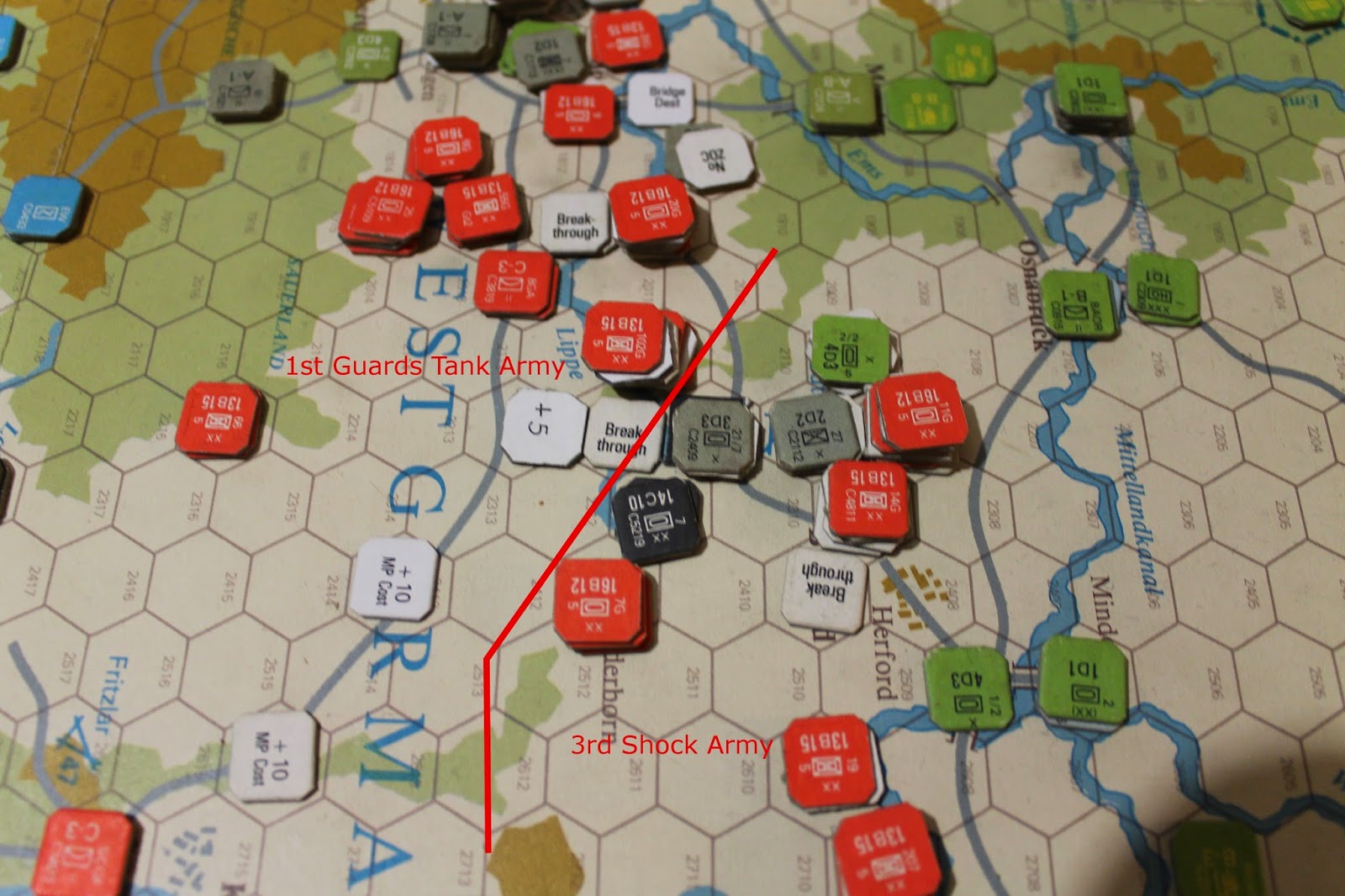
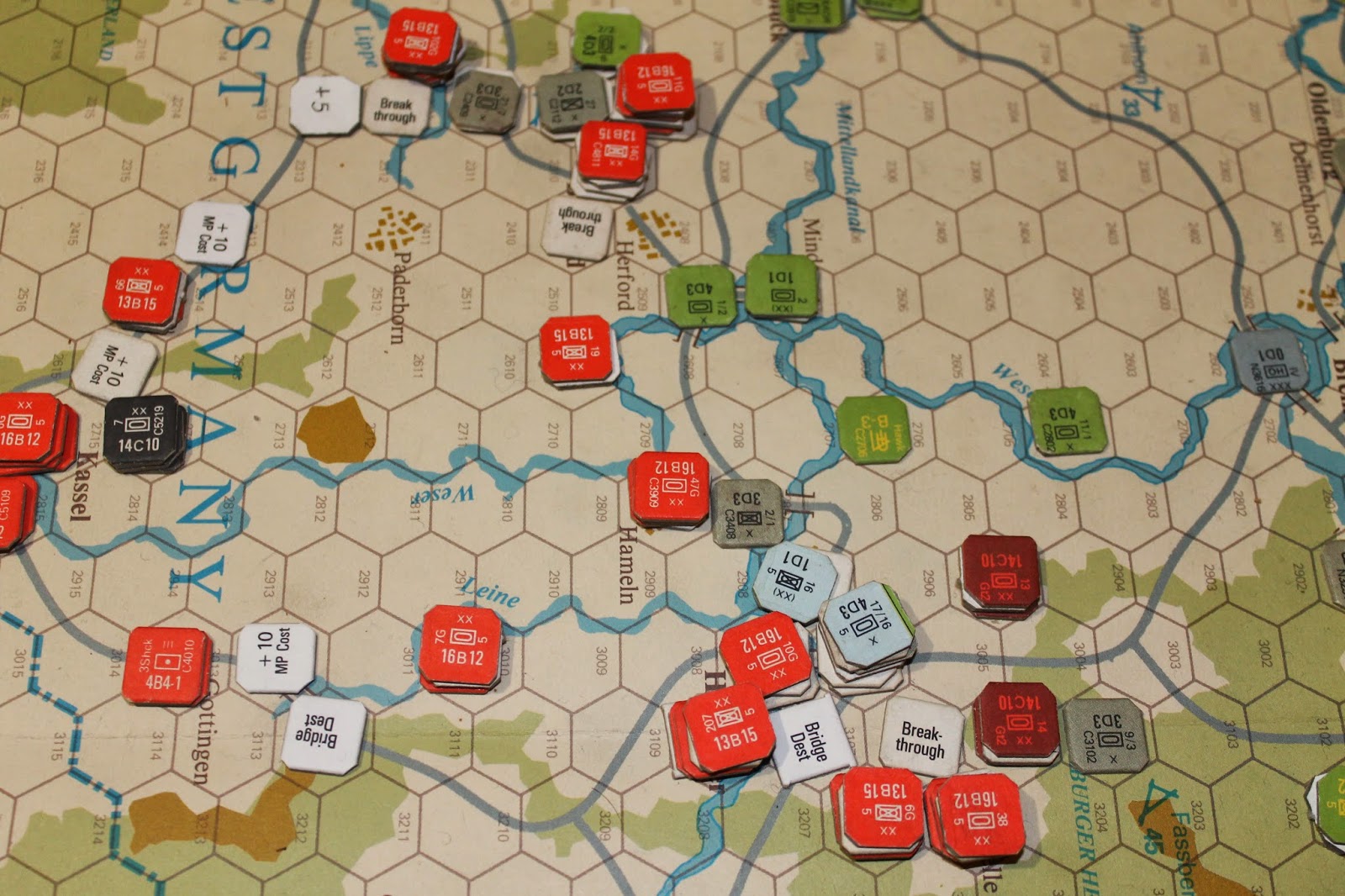
In the final hours of D+3, the rearguards divisions of 3rd Shock and 1st Guards Tank Armies moved forward, getting ready to attack at the following dawn.
3rd Shock Army positions at D+3, 18:00 Zulu Time


3rd Shock and 1st Guards Tank Armies positions, D+3 18:00 Zulu Time
1st Guards Tank Army positions, D+3 18:00 Zulu Time


At 18:00, May 6, 1980 (D+3), a cursory look at the strategic situation in Europe Central Front suggested a triumphant advance of Warsaw Pact's steamroller, with little or no chance for the West to stop it before the Rhine. NATO propaganda had a hard time trying to persuade the public opinion that despite the appearances the battle had just begun, particularly after years of insane declarations about the "forward defence" strategy in West Germany.
Overall situation at 18:00, D+3 Zulu Time
NATO corps are not outlined due to the blurred defence lines  


Actually, Warsaw Pact forces had several problems, and not all of them came with a handy solution.

  • The Air Force was in terrible shape and probably unable to contest NATO superiority for more than 2 days
  • Poland defection and Czech revolts subtracted at least 15 Division from available forces, leaving a weakened North Germany Front and forcing the other Fronts to overextend their assigned area
  • Most Armies only had two more days of supplies available, after which they would have to receive them using railroads and Front Supply Heads
  • Lines of communication and supply were fragile and only lightly defended, with several key bridges and crossing constantly hammered by NATO helicopters and airplanes
However, the second strategic echelon of Soviet forces was expected in East Germany starting from D+7. If Pact's forces were able to keep momentum for another few days, the almost continuous flow of second-line Divisions would solve most of the problems.


Friday, 21 March 2014

The Next War - Operation Attila - Timeline

Due to an error in days counting, I have revised and changed the overall timeline of the posts.

The (hopefully) exact timeline is now as follows:
April 29, 1980  D-4  turn 1, tension
April 30, 1980  D-3  turn 1, tension
May 1, 1980     D-2  turn 2, tension
May 2, 1980     D-1  turn 2, tension
May 3, 1980     D+0  turn 3, war begins, WP use chemical weapons
May 4, 1980     D+1  turn 3, war
May 5, 1980     D+2  turn 4, war, Hanover falls 
May 6, 1980     D+3  turn 4, war
May 7, 1980     D+4  turn 5, war, Munich and Nuremberg fall
May 8, 1980     D+5  turn 5, war, W. Germany troops evacuate Hamburg
May 9, 1980     D+6  turn 6, war, WP supply heavily damaged by air attacks
May 10, 1980    D+7  turn 6, war, NEDEFOR formed
May 11, 1980    D+8  turn 7, war, Netherlands Surrender, Denmark invaded
May 12, 1980    D+9  turn 7, war, NATO Operation "Hand of God" starts
May 13, 1980    D+10 turn 8, war, WP supply lines collapsed
                                  WP 2nd echelon troops arriving in W. Germany
May 14, 1980    D+11 turn 8, war, NATO SOUTHAG retreats 75 km
May 15, 1980    D+12 turn 9, war  Hamburg falls

I noticed the error while reading the New York Times from the first day of war:


Wednesday, 19 March 2014

The Next War - Operation Attila - D+3 (2)

Warsaw Pact Land Movement continues. 
Losses are moderate until now, but the decreasing chemicals effectiveness is giving me some problems. Moreover, without the standard rules +2 modifier in Division vs. Brigade attacks, a well-placed NATO brigade can become a hard nut to crack.


Battle for Hanover

10 Guards Division assaulted frontally the city centre, destroying 4/16 Belgian brigade defending it.

20 Guards Army North pincer had heavy fighting with 8/3 German brigade, that held ground for almost 36 hours stopping 2 assaulting divisions before retreating inside Hanover. Two Czech divisions of the Army rushed in to exploit the breakthrough, but they were unable to complete the encirclement and destroy the Dutch SAM site West of the city.

3rd Shock Army South pincer was not lucky too, as 2/1 German brigade stopped its forward Division at Hameln.

The rest of 3rd Shock Army, with heavy artillery support, smashed BAOR defences around Bielefield / Herford, encircling two German brigades at Gutersloh airport.


3rd Shock and 20th Guards Armies situation


Rush to the Ruhr

1st Guards Tank Army continued moving toward the Rhine. 
1st British Recce Regiment, directly on its advance path, was hit by SSM delivered chemicals and subsequently surrounded and destroyed by 20th and 55th Guards Divisions.

The rest of the Army, even though unable to use the helicopter-ridden autobahn, moved West at double speed and reached the outskirts of the Ruhr. Its spearhead Division, 27th Guards, crossed Lippe river and stopped 30 km from the Rhine.

Inside the Ruhr urban area, the survivors of two Soviet airborne Divisions dispersed and fortified to better defend from the continuous air-to-ground attacks by NATO helicopters.
1st Guards Tank Army advance

Friday, 28 February 2014

The Next War - Operation Attila - D+3

Air War

After several hot discussions in Moscow, Warsaw Pact decided to continue using the saturation tactics in the air struggle against the Western Capitalists.
In North and Central sectors, strong groups of air superiority fighters were assigned, assisted by smaller groups of MIG-21 used to overstretch NATO's air forces.
In the South sectors, Hungarian air units with a small Soviet complement were expected to force the Italians to give up the control of their air space.

It wasn't a good decision.
At sunset of May 6 (D+3) Warsaw Pact held Air Superiority in the North and South sectors, but in the centre American F15 and F4 emerged victorious, opening up a corridor for REFORGER airlift.

Moreover, MIG-21 and MIG-23 losses have been even higher than the previous days, up to the point of questioning Pact's capability to contest air control in the near future. Every airfield in East Germany was littered by damaged or inoperable aircraft, well beyond ground crews' repair capabilities, plagued as always by a spare parts shortage.

Pact Special Forces Assault Phase

In preparation to the assault on I Belgian Corps' positions in Hannover, 3rd Shock Army requested a special forces assault on the Dutch Hawk SAM batteries located 30 km West of the city.
The assault was carried out by 3 Soviet and 1 East German Spetsnaz units and went bad since start. Due to a probable information leak, 4 MI-6 were shot down during the approach phase and the attacking commando was welcomed by 100 West German Police agents and mixed Military Police units, supported by a couple armored vehicles.
After 2 hours of firefight, the whole assault force was killed or forced to surrender without being able to damage the Hawk batteries. 

Pact Airborne Assault Phase

In order to support 1st Guards Tank Army advance toward the Ruhr, 76th Guards Airborne Division was transported to Bottrop, 30 km behind German III Corps Main Battle Area, by helicopters flying in NOE mode. The division had just the time to consolidate before several American Cobra helicopters attacked its positions,inflicting moderate losses. To prevent further losses, the remaining Cobra assault helicopter were quickly grounded by a coordinated SSM-delivered chemical attack on their airports.

Pact Land Movement

In South Germany, after an SSM delivered chemicals disabled German II Corps' artillery supporting Nuremberg's defenders, Czech 1st Army assaulted the city with heavy artillery support. NATO positions were overrun and 3 divisions exploited the breakthrough crossing the Danube, suffering some losses due to a stiff resistance by the retreating 10/4 German brigade.

At the end of the battle, the whole area around Nuremberg had been contaminated by persistent chemicals. In an official declaration released at 22:00, May 6 (D+3), Warsaw Pact spokesman Major -General Yuri Lebedev declared that "in the previous days NATO refused our offer to declare Nuremberg Open City. This ill fated decision brought suffering to the same German citizens NATO declares to protect, and caused the almost total destruction of one of the finest cities in central Europe."
The ruins of Nuremberg


Further South, the Hungarian Army entered Munich, but failed to dislodge the 1st mountain Division Base defending the center of the city. Due to accumulated fatigue and NATO opposition, the whole Army get bogged down around Munich.
Hungarian Army situation